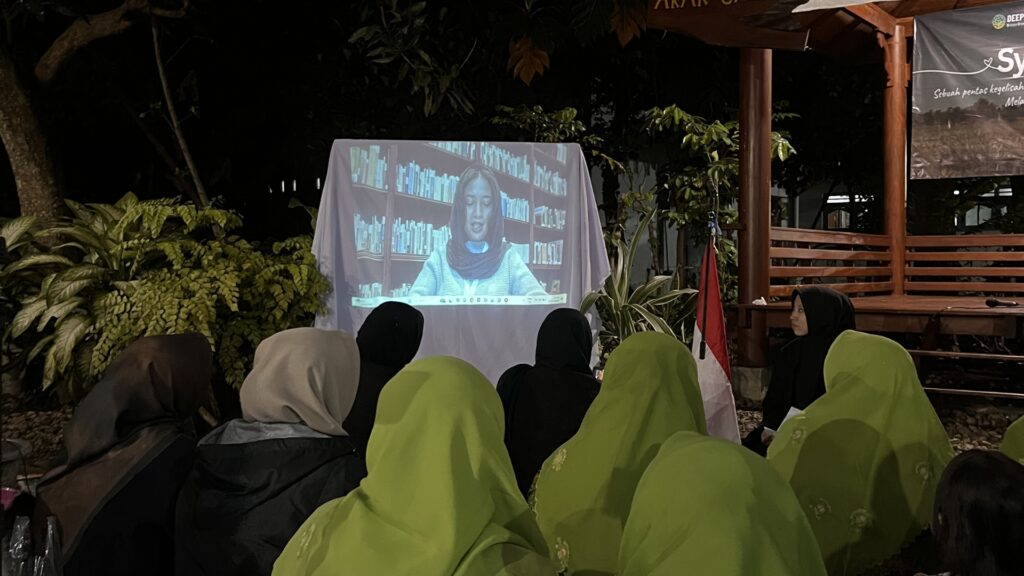
One of rural coastal areas in Pemalang, Central Java became a meeting point for lives shaped by the shifting boundary between land and water. Organized by DEEP EnGender in collaboration with Akar Cahaya Indonesia, and supported by IPNU–IPPNU Pemalang, Syair dari Pesisir brought together 64 participants spanning from women, youth, performers, village representatives, and community members. On the evening of 27 March 2026, they gathered to inhabit a shared space formed by everyday experiences of flooding, uncertainty, and survival.
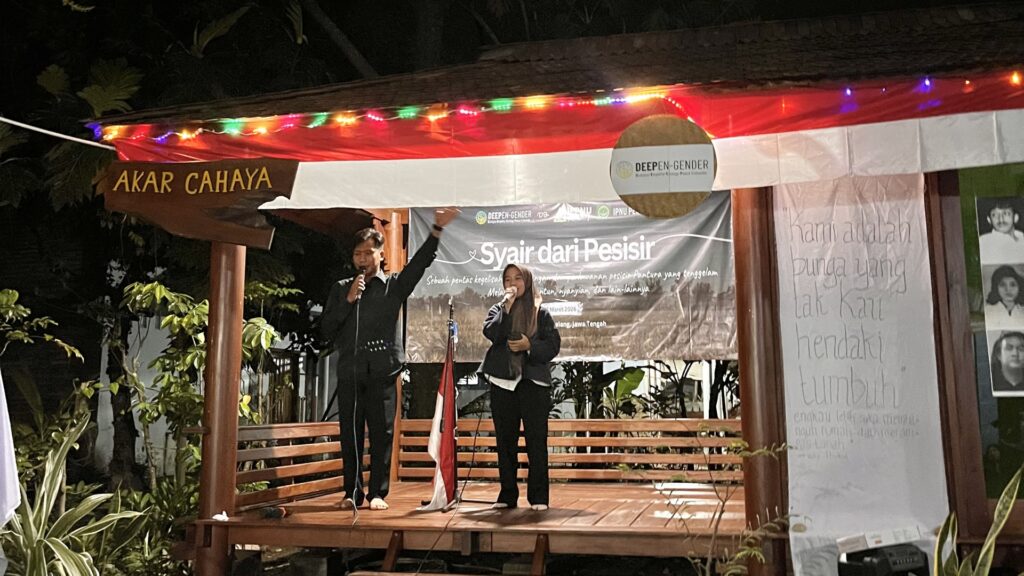
In some northern coast (Pantura: Pantai Utara) areas in Pemalang and Pekalongan, flood is a condition that recurs, enters homes, interrupts routines, and reshapes how people organize their lives. These realities are often narrated differently. Flood becomes a matter of rainfall, a technical issue, a statistic to be recorded, or an “impact” to be assessed. In this translation, the complexity of lived experience is reduced, and the structures that produce vulnerability are obscured. The more the phenomenon is measured, the less it is understood in relation to the lives it transforms. What unfolded during Syair dari Pesisir moved against this tendency. The evening began with familiar expressions of the locals such as Kasidah music, greetings, and shared presence, but gradually, the space shifted in function. The stage became a site where experiences could be articulated in their own terms. Through poetry, storytelling, humor, and performance, locals brought forward fragments of everyday life that, when placed in relation to one another, began to reveal patterns.
A poem questioned the relationship between citizens and the state, asking where responsibility resides when crises persist. A retold folktale unsettled the assumption that environmental damage is accidental, instead suggesting that it is produced through human action and decision. A young participant spoke of water not as a temporary disruption, but as inheritance something carried forward across generations, unresolved and ongoing. In another moment, a woman stood on stage and made the audience laugh as she spoke of flooded kitchens, economic pressure, and the fatigue of continuing. The laughter did not diminish the weight of her words; it made them collectively recognizable. Humor became a way of holding together what might otherwise remain unspoken.
These expressions did not simply describe reality; they interpreted it. What is often categorized as personal experience began to function as a form of analysis. The flood, as it appeared through these narratives, was no longer singular or natural. It was revealed as something shaped over time, inter alia, through environmental degradation, extractive practices, and decisions that unevenly distribute risk. Those who carry its consequences most directly are often those with the least capacity to influence these processes.
This initiative, from lived experience toward structural understanding, resonates with what Anna Tsing describes as the importance of attending to how people live within damaged environments, not as passive subjects but as active interpreters of their conditions. In Pemalang, the everyday is a site where knowledge is produced. At the same time, the gathering challenges the assumption that valid knowledge must be abstracted from place. Taking this discourse further, what emerged aligns with Arturo Escobar’s argument that communities generate their own ways of understanding the world in a sense that do not separate ecological processes from social relations, nor experience from analysis.
In addition, the prominence of women’s voices throughout the evening further unsettled dominant frameworks of knowledge. The realities they articulated were not detached observations, but embodied understandings shaped through care work, labor, and repetition. Flood is known through cooking in waterlogged kitchens, through maintaining households under strain, through sustaining life under conditions that are neither temporary nor accidental. In this sense, the gathering echoes what Vandana Shiva has long emphasized, that ecological knowledge is deeply embedded in everyday practices of sustaining life, and that those most affected are not merely victims, but central producers of knowledge about the crisis.
As the evening progressed, the distinction between performer and audience began to dissolve. Participants moved beyond the curated program, adding their voices, continuing songs, and sharing stories in response to one another. The space became increasingly collective, not defined by presentation but by relation. What emerged was not a single narrative, but a shared recognition that individual experiences are interconnected and that their meaning deepens when they are held together. Departed from here, Syair dari Pesisir cannot be understood simply as a cultural event. It functioned as a space where lived realities were not extracted, but articulated; where knowledge was not imposed, but generated; and where experiences that are often fragmented were allowed to gather into a collective voice. For DEEP EnGender, this reflects an approach that places cultural practice at the center of engagement, recognizing that ecological and gender justice cannot be separated from how knowledge is produced, shared, and recognized.
In a broader context where ecological crises are frequently framed as technical or inevitable, what emerged in Pemalang offers a different perspective. It insists that these crises are shaped by histories, decisions, and power relations. It shows that those who live through them are not passive recipients of impact, but active interpreters of their conditions. And it demonstrates that when these interpretations are brought together, they can begin to form the basis of collective understanding and action.
Because what is often called “natural” is, in fact, structured. And what is structured can be named, contested, and therefore, ultimately, transformed.