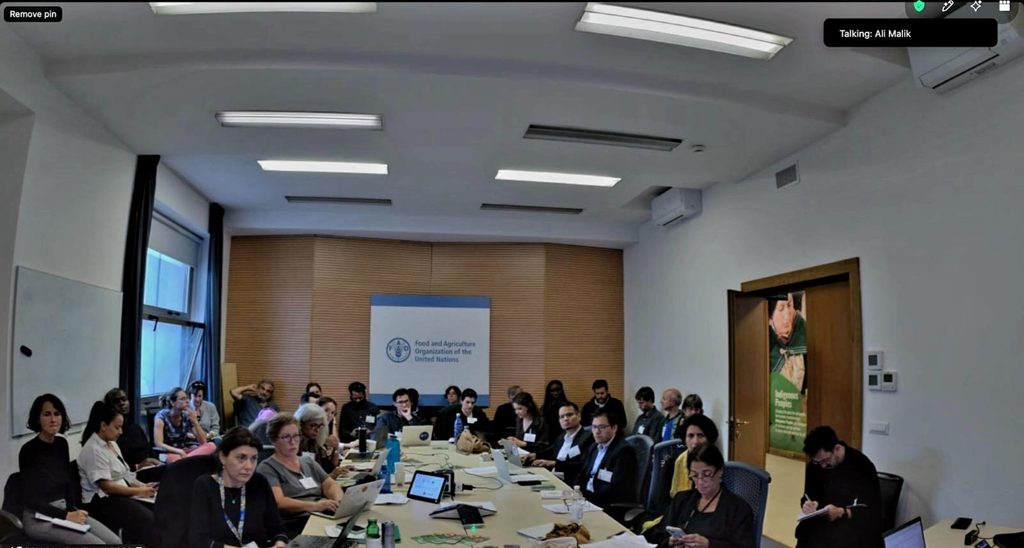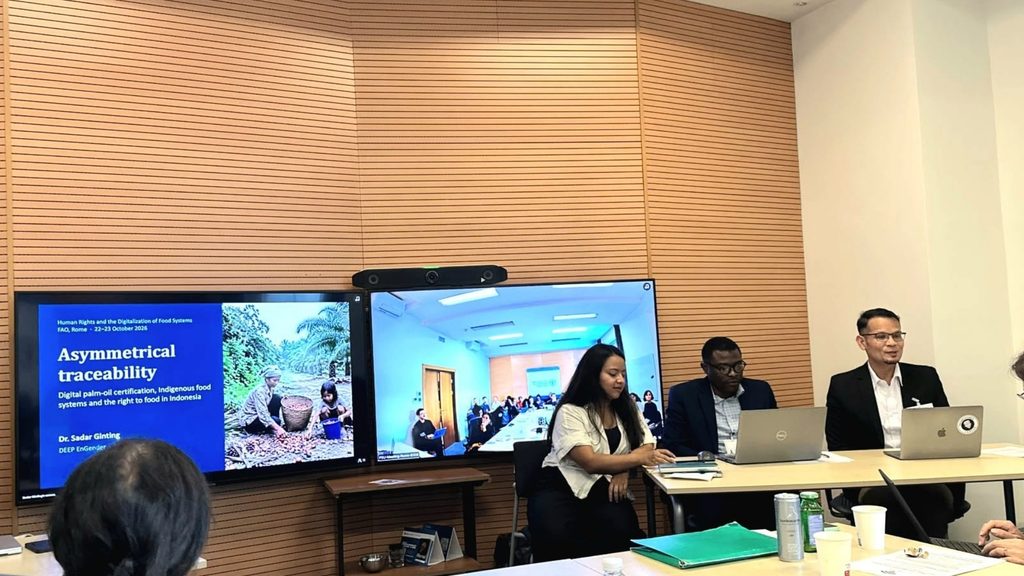
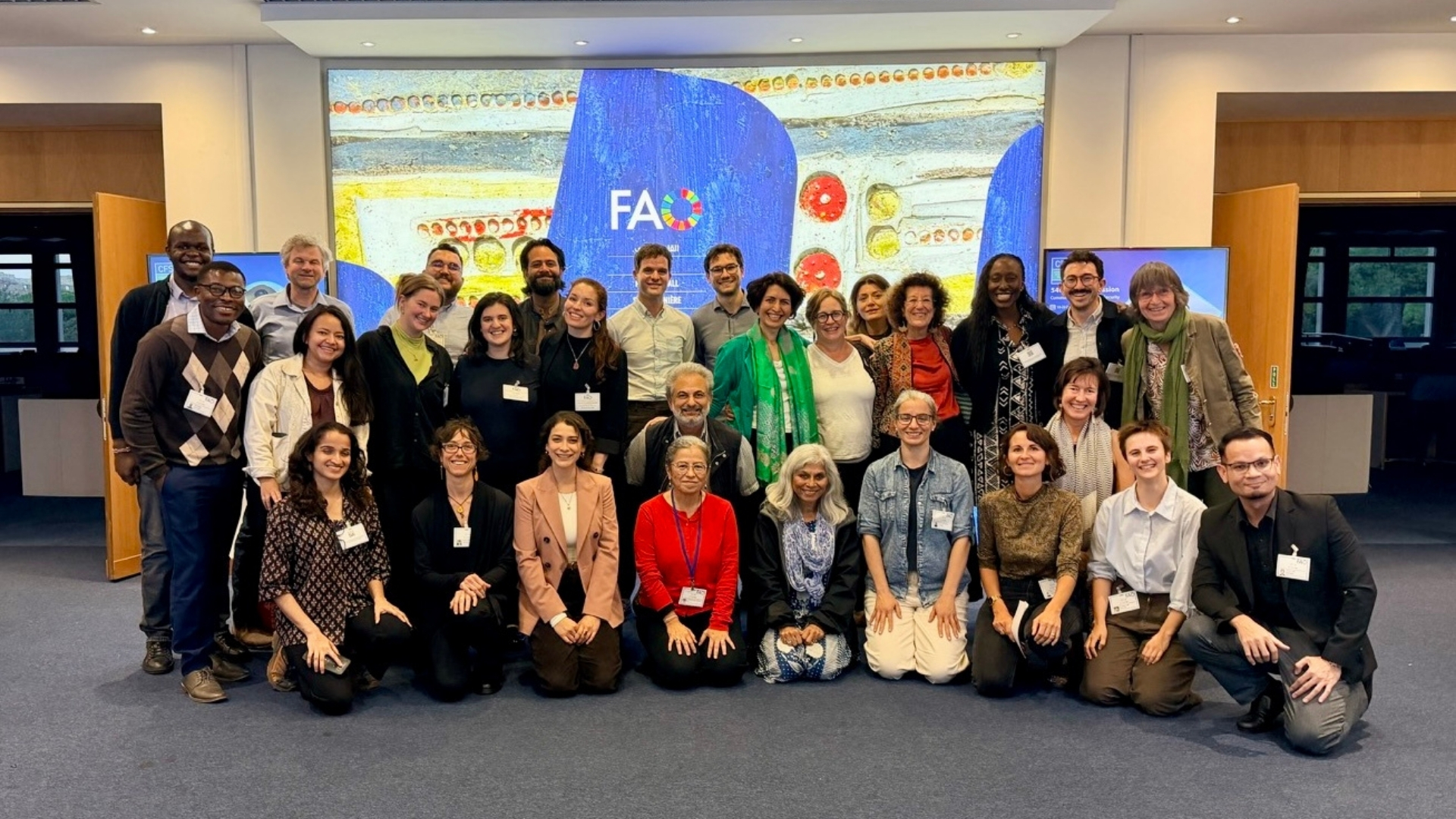
In late October 2026, DEEP EnGender took part in Human Rights and the Digitalization of Food Systems, a workshop held at FAO headquarters in Rome on 22–23 October. The workshop was convened by the DIGIFOOD project at Leiden University, together with the mandate of the UN Special Rapporteur on the Right to Food and the UN Working Group on the Rights of Peasants and Other People Working in Rural Areas, and it brought together people who study and shape how data and digital platforms are changing food systems. On behalf of DEEP EnGender, Sadar Ginting, DrPH, PhD, our Executive Director and Co-Founder, shared reflections from our long-term work with Suku Anak Dalam (Orang Rimba) communities in Merangin, Jambi. A full research article is being prepared, so this post shares the questions and ideas behind the presentation rather than its detailed findings.
Our starting point was a simple observation. For Suku Anak Dalam families, food is never only a matter of quantity. It is shared, it follows rules about who eats first, and it is bound up with the forest, the river and the knowledge of elders. Over recent decades, however, much of that forest has become oil palm; in Jambi alone, the area planted with oil palm has grown roughly sixfold since 1990. As a result, many families now meet the plantation economy not as owners or workers, but as gatherers of the loose fruit that falls after the harvest, which they sell to buy rice.
At the same time, Indonesia is building a new digital platform for its national palm-oil certification, known as SI-ISPO. The platform is designed to record certified plantations, their boundaries and their trades in great detail, and to help show European buyers that Indonesian palm oil meets the EU’s new deforestation rules, including respect for land rights and the rights of Indigenous peoples. In principle, this is welcome: more transparency in a commodity long linked to deforestation. Yet it also raises a question that is easy to overlook. If a system can follow a palm fruit from the field to the mill, can it also see what has happened to the people whose food, forest and land were changed by that plantation?
This is the question we explored through the idea of asymmetrical traceability. Digital systems are very good at recording things that come in clear units, such as a mapped plot, a date, a signed form or a sale. Indigenous knowledge of loss, by contrast, often lives in relationships: in memories shared among relatives, in places used in turn over many years, and in food divided so that everyone receives a share. When such knowledge must first be converted into units before it can count, much of its meaning is lost along the way. In other words, the commodity becomes ever easier to trace, while the people around it can remain hard to see.
This matters now because SI-ISPO is still under construction, and the EU Deforestation Regulation starts to apply at the end of 2026. Choices that look technical, such as which fields a database contains, who may file a complaint and in what form, or which date marks the start of “deforestation”, will shape whose losses can be recognised for years to come. Once these categories are built into systems that other agencies and buyers rely on, they become much harder to change. For this reason, the presentation argued that the best moment to ask human rights questions about a digital system is before it goes live, not after.
Importantly, the answer is not simply to put more Indigenous data into the platform. Mapping sacred places or food sources and handing them to a database could expose knowledge that communities have good reasons to protect. Instead, the presentation pointed towards reciprocity rather than absorption. Communities living beside certified plantations should be able to see the data on which those plantations are judged, and their own institutions should decide what, if anything, enters the system and on what terms. For buyers, the implication is equally clear: when a system shows no complaint, that silence is a gap in the information, not proof that no harm has occurred.
Behind these ideas lies a way of working that DEEP EnGender has built over many years. The perspectives shared in Rome came from customary leaders, senior women and elders, the people whom Suku Anak Dalam custom recognises as able to speak with outsiders, and they grew out of regular, trusted engagement rather than a single research visit. Throughout, we follow the communities’ own rules about what may be shared and what must stay within the community. That is why we do not publish settlement locations or the places where food is found, and why any proposals that follow from this work remain for Suku Anak Dalam institutions themselves to take up or set aside.
Taken together, the presentation offered a simple standard for the digitalisation of food systems, in Indonesia and beyond:
“A system that can trace every fruit should be able to see what that fruit feeds.”
We thank the DIGIFOOD team for the invitation, our fellow participants for a generous exchange, and above all the Suku Anak Dalam knowledge holders of Merangin, on whose knowledge and trust this work rests.