
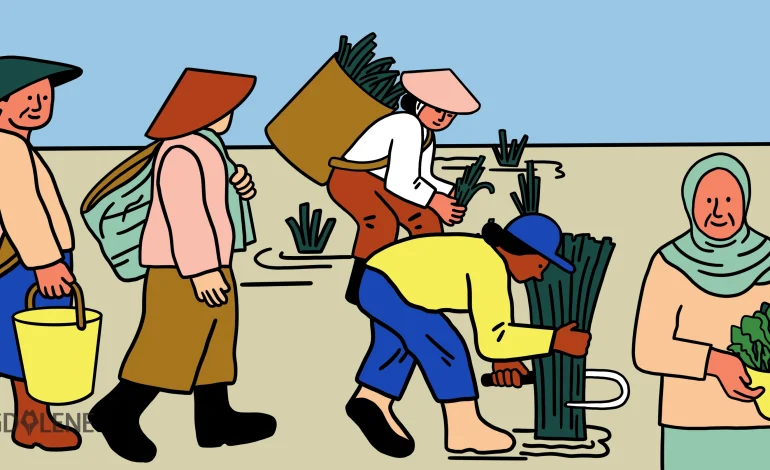
When the Men Leave, Women Hold Up the Fields—But Structural Injustice Remains

Other publication / Published on Magdalene

This article explores the everyday realities faced by women farmers in Sirnabakti Village, Garut, West Java, where women increasingly sustain agricultural production while men migrate to cities for work. The daily routine of many women begins before dawn with household responsibilities such as cooking and childcare, followed by hours of labor in the rice fields. Even after returning home, domestic work continues, often accompanied by additional income-generating activities. In this setting, women’s labor moves constantly between the household and the fields, creating overlapping responsibilities that rarely pause.

Although women now make up a larger share of agricultural laborers in the village, this does not translate into improved welfare. Many women farmers are landless or own only very small plots, leaving them dependent on selling their labor to landowners. Wages remain unequal, with women typically paid significantly less than men for different agricultural tasks. Their work is often framed as supplementary income for the household, even though it frequently plays a crucial role in sustaining family livelihoods.

Beyond wage inequality, women also face structural barriers to technology and mobility. Cultural norms restrict women from using certain farming tools or operating machinery, which limits their participation in higher-paid or technologically assisted tasks. As a result, women remain concentrated in labor-intensive activities such as planting, harvesting, and weeding.

Despite these constraints, women in Sirnabakti demonstrate resilience and collective agency. Through community organizations and local networks, they share agricultural knowledge, manage household finances, and support each other in navigating economic pressures.

The article concludes that addressing these inequalities requires structural change, including equal wages, improved access to technology, and stronger recognition of women’s central role in agriculture. Without such reforms, the burdens carried by women farmers will continue to shape both rural livelihoods and the opportunities available to future generations.

Read the full article on Magdalene ↗

DEEP EnGender Author

Daniel Jeremia Natanael Nababan

Mr. Daniel Jeremia Natanael Nababan is a social researcher focusing on environmental governance and climate policy, with particular attention to European Union–ASEAN relations. His academic work examines the political dimensions of climate governance, including the mechanisms of European Union climate hegemony toward ASEAN countries and the implementation of EU forest fire policies in the post-pandemic context. He holds a Bachelor of Social Sciences in Sociology from Universitas Negeri Jakarta and a Master of Science in European Studies from Universitas Indonesia.

When the Men Leave, Women Hold Up the Fields—But Structural Injustice Remains Read More »

Why Gender Sensitivity Matters for Disaster Risk Reduction in Indonesia

Other publication / Published on Konde.co

This article examines why gender sensitivity is essential for effective disaster risk reduction in Indonesia. It argues that the country’s disaster responses, illustrated by the COVID-19 pandemic and the 2025 floods in Sumatra and Aceh, have largely been shaped by centralized, command-driven governance that prioritizes speed, control, and visible state authority. While these approaches aim to manage emergencies efficiently, they often overlook gender-responsive planning and the everyday realities faced by women during crises.


In many disaster contexts, women experience disproportionate impacts. During the pandemic and post-flood recovery, women carried heavier burdens of unpaid care work, faced heightened risks of gender-based violence, and encountered barriers in accessing aid and recovery programs. Emergency shelters and relief systems frequently lacked adequate attention to privacy, reproductive health services, childcare, and safety, issues that directly affect women’s wellbeing. At the same time, the article highlights that women are not simply vulnerable victims. Across Indonesia, women have demonstrated strong grassroots leadership in disaster response. They organize community kitchens, coordinate local relief networks, care for children and elderly residents, and help maintain social cohesion during crises. Indigenous women also contribute important ecological knowledge that supports long-term environmental stewardship and community resilience.


Despite these contributions, women’s roles remain underrecognized in formal disaster governance. The article therefore calls for stronger integration of gender perspectives in emergency policies, including gender-disaggregated data, women’s participation in decision-making, and the recognition of Indigenous women’s knowledge in environmental and climate policies. Strengthening gender-sensitive governance, the article concludes, is not only a matter of equity but also a practical step toward building more resilient and sustainable disaster responses in Indonesia.rticle explores why gender sensitivity is crucial for disaster risk reduction in Indonesia.


The piece highlights how disaster governance in Indonesia often relies on centralized and militaristic approaches that overlook gender perspectives. As a result, women’s specific vulnerabilities and contributions in crisis response remain underrecognized. The article emphasizes that women are not only among the most affected during disasters, but also play critical roles in community resilience organizing mutual aid, managing shelters, supporting livelihoods, and sustaining local knowledge. Strengthening gender-responsive disaster governance is therefore essential to build more just and resilient communities.

Read the full article on Konde.co

DEEP EnGender Author

Daniel Jeremia Natanael Nababan

Mr. Daniel Jeremia Natanael Nababan is a social researcher focusing on environmental governance and climate policy, with particular attention to European Union–ASEAN relations. His academic work examines the political dimensions of climate governance, including the mechanisms of European Union climate hegemony toward ASEAN countries and the implementation of EU forest fire policies in the post-pandemic context. He holds a Bachelor of Social Sciences in Sociology from Universitas Negeri Jakarta and a Master of Science in European Studies from Universitas Indonesia.

Why Gender Sensitivity Matters for Disaster Risk Reduction in Indonesia Read More »

Scroll to Top