Journal article / Published on "Antro-polus Journal"
Some forms of peace are difficult to see. Peace does not emerge through treaties, state institutions, or development agendas. They live in the quiet rhythms of everyday life, in gathering forest food, caring for children, remembering ancestral pathways, protecting seeds, and sustaining relationships with the land. Yet these practices are often absent from how peace, security, and development are imagined.
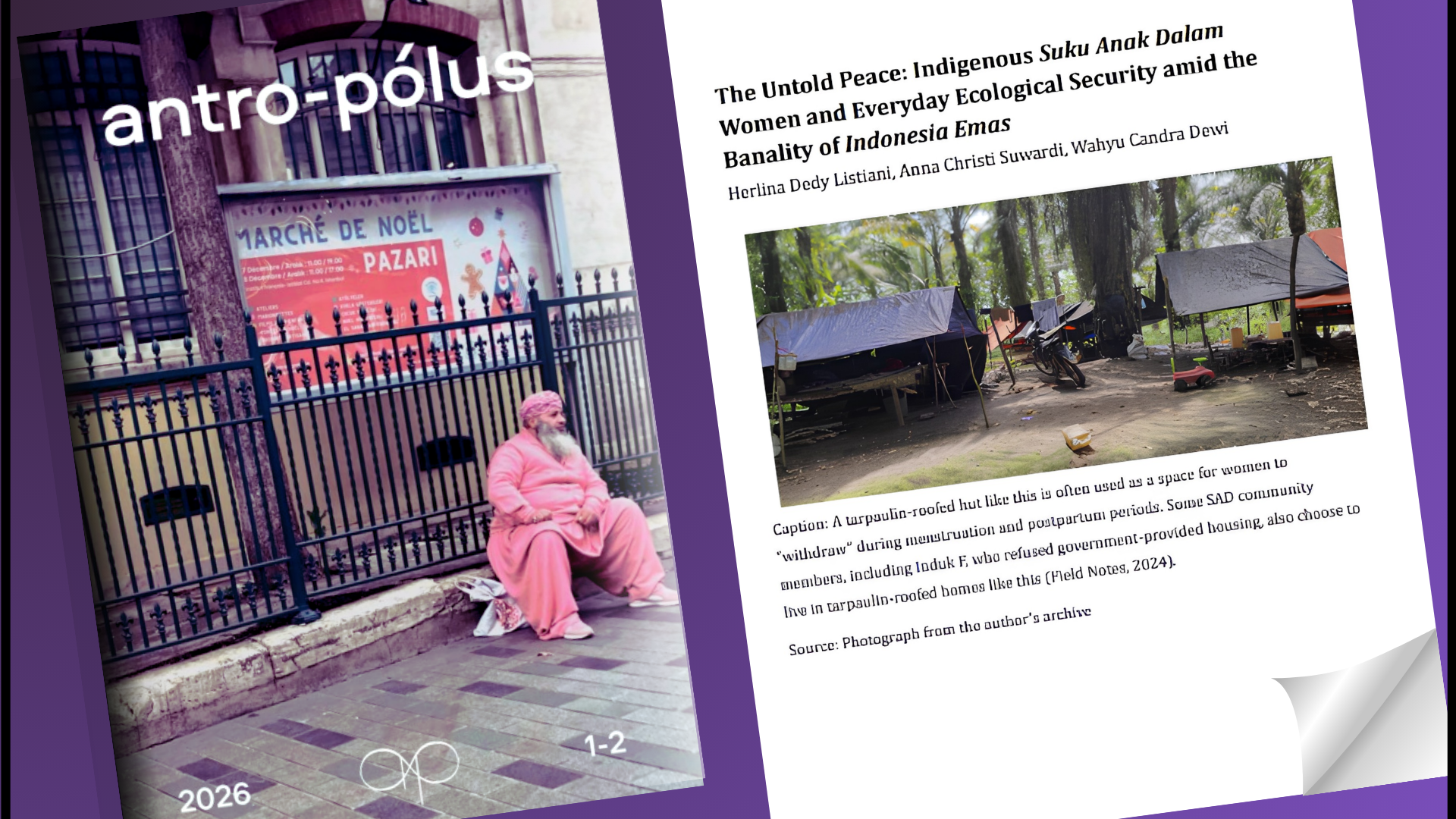
It is from this reflection that our latest publication, "The Untold Peace: Indigenous Suku Anak Dalam Women and Everyday Ecological Security amid the Banality of Indonesia Emas," begins.
Published in Antro-polus Journal, the article is written by Herlina Dedy Listiani, Anna Christi Suwardi, and Wahyu Candra Dewi
The article accompanies the everyday lives of Indigenous Suku Anak Dalam (SAD) women in Jambi, whose relationships with forests continue to be transformed by the expansion of oil palm plantations and industrial forestry. As customary territories are reconfigured through extractive development, the consequences are not experienced only through the loss of land. They are also felt through changing food systems, disrupted relations of care, diminishing ecological knowledge, and the gradual narrowing of spaces where life can continue to flourish.
Drawing inspiration from Hannah Arendt's reflections on the banality of evil, the article explores how violence is not always enacted through spectacular moments of destruction. It can also become embedded within bureaucratic routines, policy language, and development aspirations that present extractive transformation as ordinary, necessary, and inevitable. Through the promise of Indonesia Emas 2045, the article reflects on how optimism itself can become a political language that conceals unequal burdens while presenting them as collective progress.
At the same time, this is not a story that begins and ends with dispossession.
The article listens to the ways SAD women continue to cultivate everyday ecological security through practices of care that are deeply relational, with forests, food, bodies, memory, and one another. These practices are not framed as exceptional acts of resistance. Instead, they are ordinary ways of sustaining life, carrying knowledge across generations, and refusing the erasure of Indigenous worlds. In this sense, peace is understood not as an outcome delivered by institutions, but as something continuously nurtured through everyday relations of care.
For us at DEEP EnGender, this publication is part of a longer journey of learning alongside communities whose knowledge has too often been marginalized within dominant development conversations. We hope this article contributes to ongoing dialogues on Indigenous futures, feminist peace, ecological justice, and the possibilities of reimagining security from the ground where life is lived.
DEEP EnGender Authors: Herlina Dedy Listiani, Anna Christi Suwardi & Wahyu Candra Dewi
Publication
Listiani, H. D., Suwardi, A. C., & Dewi, W. C. (2026). The Untold Peace: Indigenous Suku Anak Dalam Women and Everyday Ecological Security amid the Banality of Indonesia Emas. Antro-polus Journal.
Read the article : https://bit.ly/deeppublication