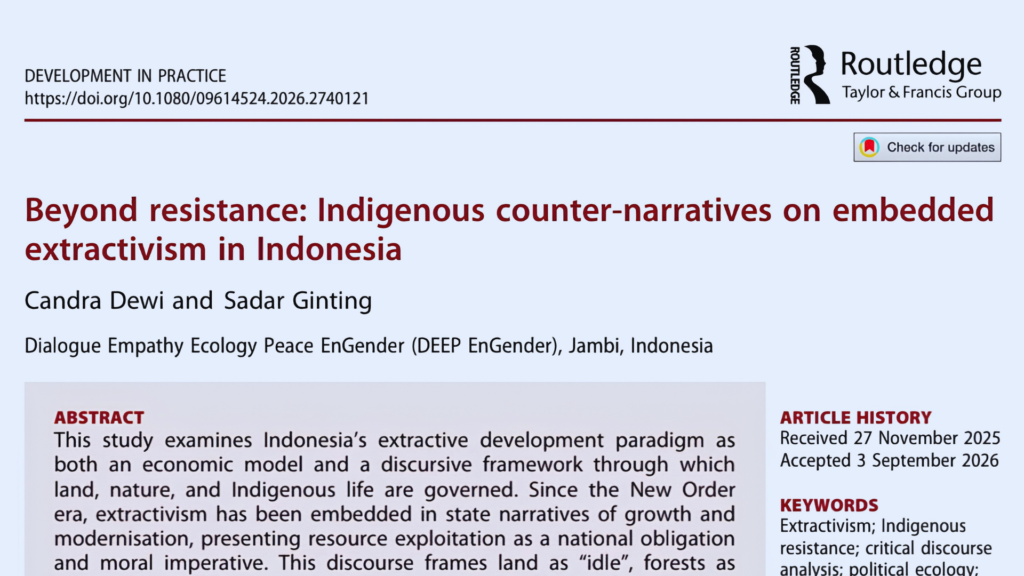
Beyond resistance: Indigenous counter-narratives on embedded extractivism in Indonesia

Journal article | Published online 5 October 2026 in Development in Practice

"Kami tidak menolak pembangunan, kami menolak ditinggalkan."
We do not reject development; we refuse to be left behind.

This statement, made by the Bala Adat Dayak community in opposing a transmigration programme and reported by Ruai TV, points to a struggle that is often misread. The issue is not whether Indigenous peoples are for or against development. It is who has the authority to define it.

Land can be described as "idle" even when it holds generations of memory, knowledge, and belonging. A forest can become a "state asset", and its conversion a measure of "progress". These words carry consequences: they shape whose relationships with land are recognised, whose knowledge counts, and whose claims can be set aside.

Our latest publication, "Beyond resistance: Indigenous counter-narratives on embedded extractivism in Indonesia," examines how the language of development helps legitimise resource extraction, and how Indigenous communities challenge the meanings through which their territories are governed.

Written by Candra Dewi and Sadar Ginting, the article combines a critical scoping review of secondary literature with critical discourse analysis. It draws on academic research, civil society reports, legal and policy documents, and media coverage in English and Indonesian.

The analysis traces how extractive development has been justified from the New Order through Reformasi-era decentralisation to the Jokowi and Prabowo administrations. The vocabulary has changed, from growth and modernisation to regional autonomy, green growth, energy transition, and resource sovereignty, while the underlying logic has persisted. These narratives gain practical force through forestry law, permits, concessions, and spatial planning. The article argues that dispossession involves more than losing access to land. It is also epistemic and ontological: it removes the authority of communities to define what land is and why it matters.

This has direct implications for climate policy. Nickel expansion for electric vehicles and batteries has been framed as energy transition, yet it relies on the same language of sacrifice, productivity, and national interest that has historically justified dispossession. Without a change in who holds authority over land, climate and energy-transition policies risk becoming greener forms of extractivism.

Indigenous responses cannot be understood through opposition alone. Drawing on publicly reported statements and documented struggles involving Dayak, Awyu, and Moi communities, the article examines how cosmology, ritual, storytelling, customary law, public testimony, litigation, and collective mobilisation contest dominant accounts of development. In these accounts, land is ancestral territory, living space, and reciprocal obligation rather than an economic asset or carbon stock.

The article also recognises that Indigenous communities do not speak with a single voice. Differences in gender, generation, leadership, livelihood, religious affiliation, and proximity to state or corporate negotiations shape how development is contested, negotiated, or pragmatically accepted. Taking these differences seriously is essential to understanding Indigenous agency without idealising it.

The study has clear limits. It relies entirely on secondary sources, so the Indigenous statements it analyses are those already reported by media and legal aid organisations, not gathered through fieldwork. It also does not offer a systematic gender analysis, although Indigenous women often carry disproportionate burdens of dispossession and are frequently excluded from compensation and negotiation. The authors identify participatory, ethnographic, and Indigenous-led research as the necessary next step.

The article concludes that compensation, technical safeguards, and corporate sustainability language are not enough. A post-extractive policy orientation requires stronger recognition of customary land rights, meaningful implementation of free, prior, and informed consent, protection of Indigenous territories from concession expansion, and the inclusion of Indigenous ecological knowledge in climate adaptation and environmental governance.

For DEEP EnGender, this publication contributes to ongoing conversations about ecological justice, Indigenous rights, and accountability in development. It calls on institutions to treat Indigenous peoples not merely as stakeholders or beneficiaries, but as political and epistemic authorities in decisions about land, forests, and collective futures.

Publication

Dewi, C., & Ginting, S. (2026). Beyond resistance: Indigenous counter-narratives on embedded extractivism in Indonesia. Development in Practice. Advance online publication. https://doi.org/10.1080/09614524.2026.2740121

Read the full article on Development in Practice ↗

Beyond resistance: Indigenous counter-narratives on embedded extractivism in Indonesia Read More »
Beyond the Promises of Development: Learning Peace from Indigenous SAD Women’s Everyday Ecological Care

Some forms of peace are difficult to see. Peace does not emerge through treaties, state institutions, or development agendas. They live in the quiet rhythms of everyday life, in gathering forest food, caring for children, remembering ancestral pathways, protecting seeds, and sustaining relationships with the land. Yet these practices are often absent from how peace, security, and development are imagined.

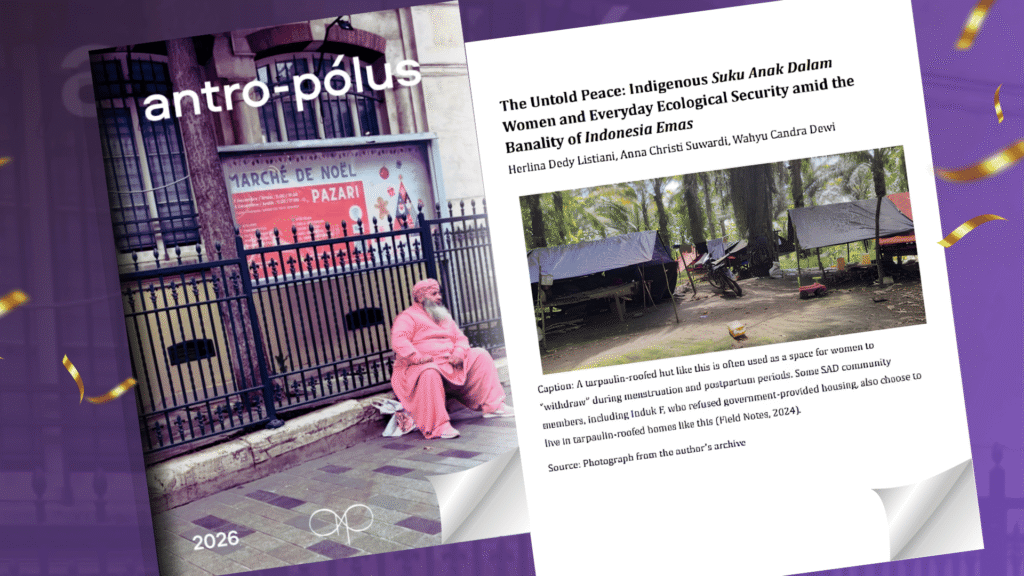
It is from this reflection that our latest publication, "The Untold Peace: Indigenous Suku Anak Dalam Women and Everyday Ecological Security amid the Banality of Indonesia Emas," begins.

Published in Antro-polus Journal, the article is written by Herlina Dedy Listiani, Anna Christi Suwardi, and Wahyu Candra Dewi 

The article accompanies the everyday lives of Indigenous Suku Anak Dalam (SAD) women in Jambi, whose relationships with forests continue to be transformed by the expansion of oil palm plantations and industrial forestry. As customary territories are reconfigured through extractive development, the consequences are not experienced only through the loss of land. They are also felt through changing food systems, disrupted relations of care, diminishing ecological knowledge, and the gradual narrowing of spaces where life can continue to flourish.

Drawing inspiration from Hannah Arendt's reflections on the banality of evil, the article explores how violence is not always enacted through spectacular moments of destruction. It can also become embedded within bureaucratic routines, policy language, and development aspirations that present extractive transformation as ordinary, necessary, and inevitable. Through the promise of Indonesia Emas 2045, the article reflects on how optimism itself can become a political language that conceals unequal burdens while presenting them as collective progress.

At the same time, this is not a story that begins and ends with dispossession.

The article listens to the ways SAD women continue to cultivate everyday ecological security through practices of care that are deeply relational, with forests, food, bodies, memory, and one another. These practices are not framed as exceptional acts of resistance. Instead, they are ordinary ways of sustaining life, carrying knowledge across generations, and refusing the erasure of Indigenous worlds. In this sense, peace is understood not as an outcome delivered by institutions, but as something continuously nurtured through everyday relations of care.

For us at DEEP EnGender, this publication is part of a longer journey of learning alongside communities whose knowledge has too often been marginalized within dominant development conversations. We hope this article contributes to ongoing dialogues on Indigenous futures, feminist peace, ecological justice, and the possibilities of reimagining security from the ground where life is lived.

DEEP EnGender Authors: Herlina Dedy Listiani, Anna Christi Suwardi & Wahyu Candra Dewi

Publication

Listiani, H. D., Suwardi, A. C., & Dewi, W. C. (2026). The Untold Peace: Indigenous Suku Anak Dalam Women and Everyday Ecological Security amid the Banality of Indonesia Emas. Antro-polus Journal.

Read the article : https://bit.ly/deeppublication

Beyond the Promises of Development: Learning Peace from Indigenous SAD Women’s Everyday Ecological Care Read More »

The Invisible Breadwinners: Stories of Women’s Care Work in Balodano

Other publication / Published on Konde.co

The article tells the story of women in rural Balodano who sustain their households and communities through care work that often goes unseen and unrecognized. It brings forward lived experiences of women who, in the absence of stable male income due to migration, step into the role of primary breadwinners while continuing to carry the full weight of domestic responsibilities.

It highlights how these women navigate a “double burden,” balancing income-generating activities such as farming and informal work with unpaid care duties like childcare, elder care, and household management. Despite their central role in maintaining family wellbeing and local economies, their contributions are rarely acknowledged within formal economic systems or policy frameworks.

At the same time, the piece emphasizes women’s resilience and agency. Through their everyday labor, they ensure food security, sustain social networks, and keep communities functioning in the face of economic uncertainty. Their knowledge and adaptive strategies reflect a deep understanding of local conditions and survival mechanisms.

However, the article also draws attention to persistent structural inequalities that limit women’s access to resources, financial support, and decision-making spaces. It calls for stronger recognition of care work and the need for gender-responsive policies that support and redistribute these responsibilities more fairly.

Ultimately, the article underscores that recognizing women as “invisible breadwinners” is essential for advancing gender justice and building more inclusive and sustainable community economies.

Read the full article on Konde.co ↗

DEEP EnGender Author

Yorizal Tri Marzuki Gulo

Mr. Yorizal Tri Marzuki Gulo specializes in Public Administration focusing on community empowerment, gender-responsive governance, and digital innovation. His work explores inclusive education and women’s leadership through participatory approaches. He has authored articles and co-authored a book on women’s empowerment. Yorizal earned his Bachelor’s and Master’s degrees in Public Administration from Medan Area University and Lambung Mangkurat University, respectively.

The Invisible Breadwinners: Stories of Women’s Care Work in Balodano Read More »

Scroll to Top