DEEP EnGender Convenes Feminist Futures Across Southeast Asia at ACWS 2026
"Care is never simply an act of kindness. It is a way of holding communities together when political violence, ecological destruction, and uncertainty seek to pull them apart."
Across Southeast Asia, places marked by conflict, disaster, extraction, and militarization are often narrated through the language of crisis. They appear on maps as borderlands, conflict zones, or vulnerable regions, while the everyday lives unfolding within them are pushed to the margins. Yet communities continue to imagine futures through quieter practices—women caring for one another, carrying memory across generations, rebuilding relationships with land, and refusing the idea that violence should define the limits of possibility.
These everyday practices became the starting point of Feminist Futures in Southeast Asia's Contested Territories: Care, Conflict, and Alternative Imaginaries, a panel convened by Dialogue Empathy Ecology Peace EnGender (DEEP EnGender) during the 2026 Asian Center for Women's Studies (ACWS) International Conference, B/ordering the Global: Transnational Feminist Critiques from Asia, hosted by ACWS, Ewha Womens University, South Korea. Bringing together scholars and practitioners from Indonesia, Thailand, and the Philippines, the panel explored how feminist knowledge emerges through lived experiences of care, memory, ecological justice, and collective survival across Southeast Asia's contested territories.
As panel organizer, DEEP EnGender coordinated the session from beginning to end. While the conference committee provided the online platform, the panel itself unfolded through DEEP EnGender's facilitation—creating a space where dialogue felt collaborative, reflective, and grounded in relationships built before participants entered the conference room.
The session was chaired by Dr. Anna Christi Suwardi, PhD, FHEA, Founder and Chairperson of DEEP EnGender, who opened the discussion by inviting participants to read the four presentations as interconnected conversations rather than separate case studies. Throughout the session, she returned to a central proposition: care is not a private virtue but a political practice that sustains communities living with prolonged uncertainty.
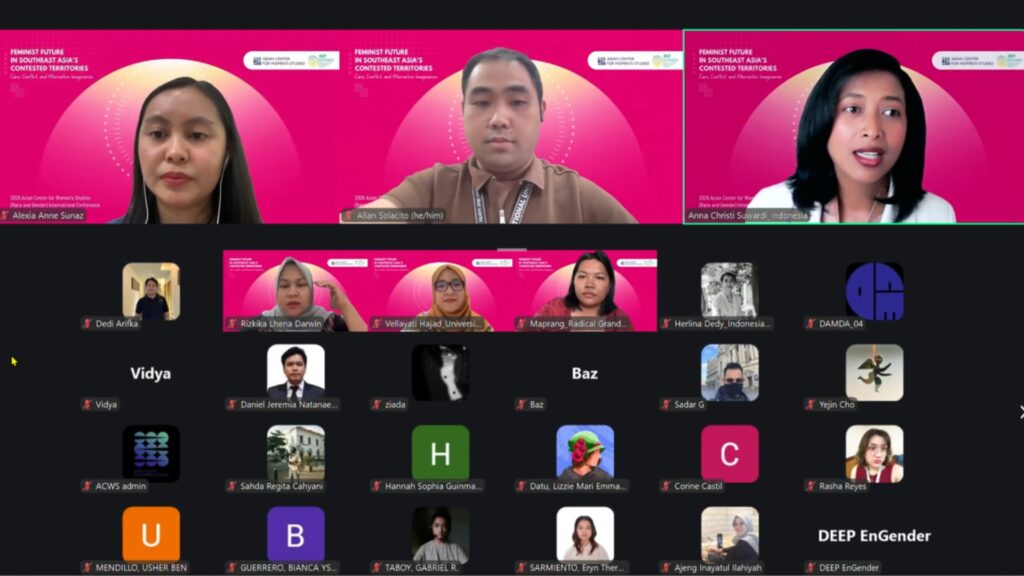
The conversation began in Mindanao, Philippines, where Allan Benedict C. Solacito and Alexia Anne M. Suñaz reimagined chismis through a feminist lens. Often dismissed as women's gossip, chismis emerged in their research as an infrastructure of care through which mothers circulate information, nurture trust, and sustain everyday economies of possibility within communities shaped by conflict.
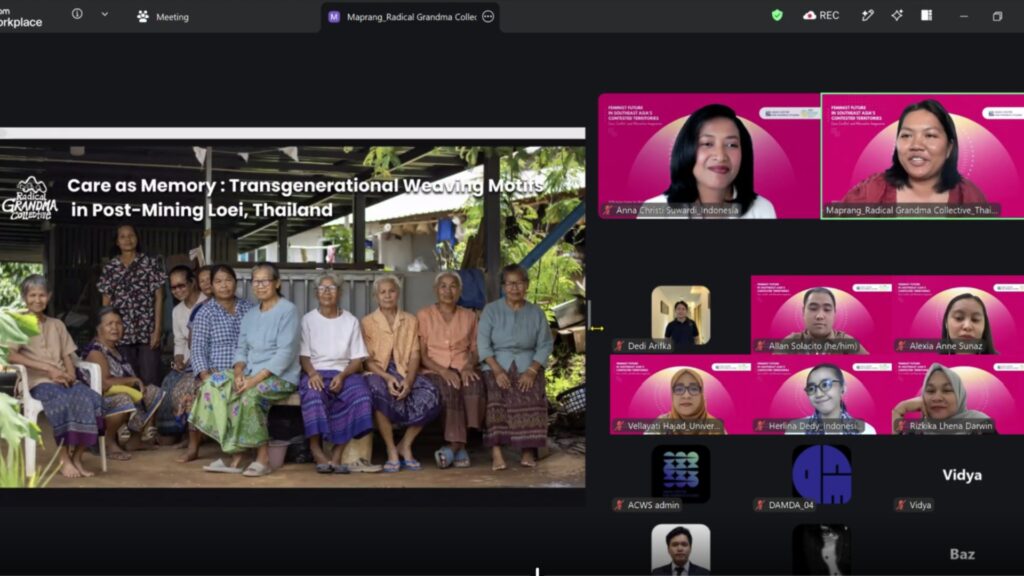
From there, participants travelled to Loei, Thailand, where Jirajade Wisetdonwail (Maprang) presented Care as Memory: Transgenerational Weaving Motifs in Post-Mining Loei, Thailand. Her presentation illuminated how women transformed weaving into a living archive after decades of ecological destruction caused by gold mining. Every woven motif carried stories of environmental loss while simultaneously preserving cultural memory, intergenerational knowledge, and aspirations for ecological regeneration.
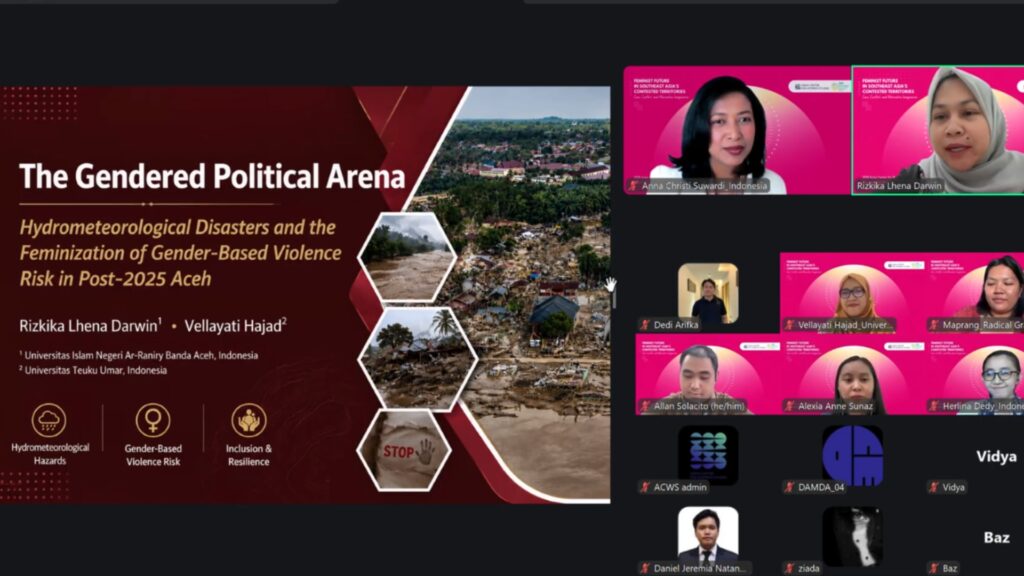
The discussion then moved to Aceh, Indonesia, where Rizkika Lhena Darwin examined hydrometeorological disasters through the lens of feminist political analysis. Her research revealed how disaster governance reshapes vulnerability, exposing women to heightened risks of gender-based violence while exposing the consequences of absent infrastructures of care during emergency response and recovery.
The final contribution unfolded through a different mode of storytelling. Herlina Dedy Listiani invited participants into DEEP EnGender's empirical work in Thailand's Deep South through a creative video narrative that foregrounded women's everyday experiences of living, caring, and sustaining community within one of Southeast Asia's longest-running conflict regions. The visual narrative offered space for the audience to encounter the textures of everyday life before entering conceptual discussion, allowing lived experience to speak on its own terms.
Building upon the video, Dr. Anna Christi Suwardi offered an analytical reflection that situated these empirical accounts within broader feminist conversations on care, borders, and protracted conflict. Drawing connections across the four presentations, she demonstrated how care takes different forms across Southeast Asia—as relational infrastructure, collective memory, ecological responsibility, and everyday political practice.
The panel concluded with Dr. Anna's closing reflection, weaving together the conversations from Mindanao, Loei, Aceh, and Thailand's Deep South into a shared feminist horizon. Care appeared not as a singular concept but as multiple political practices through which women continue to defend dignity, sustain relationships, and imagine futures in places where uncertainty has become part of everyday life.
Around 36 participants joined the session from across Southeast Asia and beyond, contributing to a lively discussion that extended the conversation across disciplinary and geographical boundaries. Vellayati Hajad reflected on the methodological possibilities of chismis as a site of inquiry within gender and public administration research, while Ajeng Inayatul Ilahiyah invited participants to reconsider how the word gossip itself has long carried gendered assumptions that diminish women's ways of producing and circulating knowledge. Sadar Ginting explored community resistance in post-mining Thailand and Annissa Vidyanita questioned the growing criminalization of LGBTQ+ communities in Indonesia's digital spaces. Responding from her own experiences as a queer activist, Maprang reflected on how online platforms have become vital spaces for solidarity, visibility, and collective action.
For DEEP EnGender, convening this panel was never solely about bringing together four presentations. It was about cultivating a space where feminist scholarship could remain accountable to lived experience, where academic inquiry could stay in conversation with community knowledge, and where relationships across Southeast Asia could continue beyond the conference itself.
DEEP EnGender Convenes Feminist Futures Across Southeast Asia at ACWS 2026 Read More »